
This week, Indonesia’s digital economy showed it can keep building through a tough market. GoTo, Superbank and Bank Jago proved that lending is now the profit engine of the super app era, while Indosat and Blibli found fresh growth in AI cloud and omnichannel retail.
Big money is also flowing into AI infrastructure, from Zankore’s GPU loan to new data centre capacity backed by IIF and Tencent. Danantara’s bid for a stake in the stock exchange could mark a turning point for investor confidence. And in What’s Next, we look at why AI literacy is fast becoming the skill every tech team needs.
Let’s dive into this week’s exciting updates.
Stay sharp,
The DailySocial Team
What’s New
Finfra Lands ADB Backing as Akulaku Regroups
Lending-as-a-service startup Finfra has secured an undisclosed investment from ADB Ventures through NextFin Asia. Its software lets banks and apps launch loan products without building their own credit operations. The deal is the fund’s first and extends Finfra’s Series A, with existing backers Cento Ventures and Accion Ventures joining in. Separately, financial regulator OJK approved Akulaku Capital Indonesia to become the holding company for Bank Neo Commerce, Akulaku Finance Indonesia and two other units. Both moves show Indonesia’s credit market building better plumbing and tighter governance as it grows.

Q3 Earnings: Fintech Carries the Super Apps
GoTo posted a Q3 net profit of Rp441 billion (US$24.3 million), its third profitable quarter in a row, and raised its full-year EBITDA guidance. Its fintech arm GoPay grew adjusted EBITDA 304%, more than offsetting the 8% commission cap on motorbike rides and showing GoTo can stay profitable under regulatory pressure. Grab-backed Superbank nearly tripled Q3 net profit to Rp117.3 billion (US$6.5 million), and its nine-month pre-tax profit jumped 376% as its digital loan book grew 265%. GoTo-backed Bank Jago lifted Q3 profit 51% to about Rp109 billion (US$6 million), with gross bad loans at just 0.9%. Payments build the user base, and lending to that base is where the profits increasingly come from.
Indosat and Blibli Find New Engines
Telco Indosat earned US$50 million from AI cloud services in the first nine months of 2026, well above the US$28 million it made in all of 2025. It expects US$100 million by year end and says it has more than US$300 million in AI cloud contracts lined up for 2027. Blibli owner Global Digital Niaga grew nine-month revenue 46% to Rp22.2 trillion (about US$1.2 billion), almost matching its full-year 2025 total. Sales to corporate and institutional buyers jumped 70%, and its operating loss shrank by more than half as it opened 31 new stores in Q3. Renting out AI computing power and blending online with offline retail are emerging as the next leg of Indonesia’s digital growth.
Affirma Capital Weighs an Exit From Travira Air
Singapore-based private equity firm Affirma Capital is exploring an exit from Travira Air, a Jakarta-based charter airline serving mining and oil and gas companies. BNP Paribas is advising, and several mid-sized PE firms are said to be in talks. Travira’s revenue reportedly rose 68% in 2025, and people familiar with the matter put its EBITDA at about US$25 million. Affirma first invested in 2015, and with the stock market in a slump, a sale to another fund would show that Indonesian exits can still get done.
Zankore Widens the Pool for Its US$3.1 Billion AI Loan
Zankore is now syndicating its US$3.1 billion loan to a wider group of lenders, after five banks underwrote it in September. The AI infrastructure venture was launched in August by Indosat and Qatar’s Ooredoo, with Nvidia and Nokia as partners. The five-year loan pays 330 basis points over SOFR, a US benchmark rate, and will buy Nvidia chips for Zankore’s first 100-megawatt AI factory. An AI factory is a data centre built to train and run AI models, and Zankore plans to scale to one gigawatt over time. Strong lender demand would mark Indonesian AI capacity as a bankable asset, not just a policy ambition.
Glints Sees SME Hiring Take Off
Job platform Glints says postings from small and medium-sized enterprises (SMEs) have quadrupled as the platform grows. That is a big opening, since co-founder Oswald Yeo has said only about 3% of recruitment in Southeast Asia happens online, against nearly 30% in the US. In Indonesia, Glints says it overtook LinkedIn and JobStreet in late 2025 on monthly Android downloads and new job listings. With operating losses down 45% last year and a group profit target for 2027, small businesses could be the segment that gets it there.
Traveloka Plugs Into a Global Hotel Network
Traveloka, the Jakarta-born travel booking app, has partnered with Emerging Travel Group (ETG), a UAE-based travel tech firm behind RateHawk and ZenHotels. Traveloka gets ETG’s hotel supply across Europe, the Middle East, Latin America and the US, while ETG can sell Traveloka’s rooms in Southeast Asia. ETG offers more than 3.2 million accommodation options and says its bookings in East and Southeast Asia have grown about 30% this year. Indonesian travellers get more choice on a local app, and Indonesian hotels get a new channel to foreign guests.
Bukalapak Founders Back a Faster AI Engine
Init-6, the early-stage fund founded by Bukalapak co-founders Achmad Zaky and Nugroho Herucahyono, has invested in Netra Runtime, an Indonesian AI inference startup. Inference is the stage where a trained AI model processes requests, so faster inference directly cuts cost. Netra’s own benchmarks show it generating four times more output per second than leading open-source engines on the same chips. It runs on Nvidia and AMD hardware and has processed more than 288 billion tokens, the small chunks of text AI models read and write. The bet is that Indonesian firms can own the layer that sets AI costs instead of renting it from abroad.
Coda and TikTok Turn Gaming Clips Into Sales
Coda, the digital goods firm founded in Jakarta in 2011, now links TikTok gaming videos directly to its Codashop store in five Southeast Asian markets, including Indonesia. Creators can feature game top-ups (in-game credit), gift cards and other digital goods in livestreams and short clips. Since the mid-June launch, those videos have drawn 1 billion views, with click-through rates above 5% and about 5% of clicks turning into purchases. Most buyers were new to Codashop, which shows creator content can bring game publishers customers they were not reaching before.

What’s Exciting
Danantara Bids for a Stake in the Stock Exchange
Danantara, Indonesia’s sovereign wealth fund, has bid for a stake in the Indonesia Stock Exchange (IDX) ahead of its demutualisation. The process turns the bourse from a body owned by its member brokers into a shareholder-owned, for-profit company, like the exchanges in Singapore and Hong Kong. Local media say Danantara could take 40%, under a September OJK rule that caps any single owner at 50%. The IDX will issue new shares to its new owners and plans an IPO later. With the main index down about 40% this year and index provider MSCI warning of a downgrade, the reform is a timely chance to win back foreign investors.
Data Centre Capital Keeps Coming
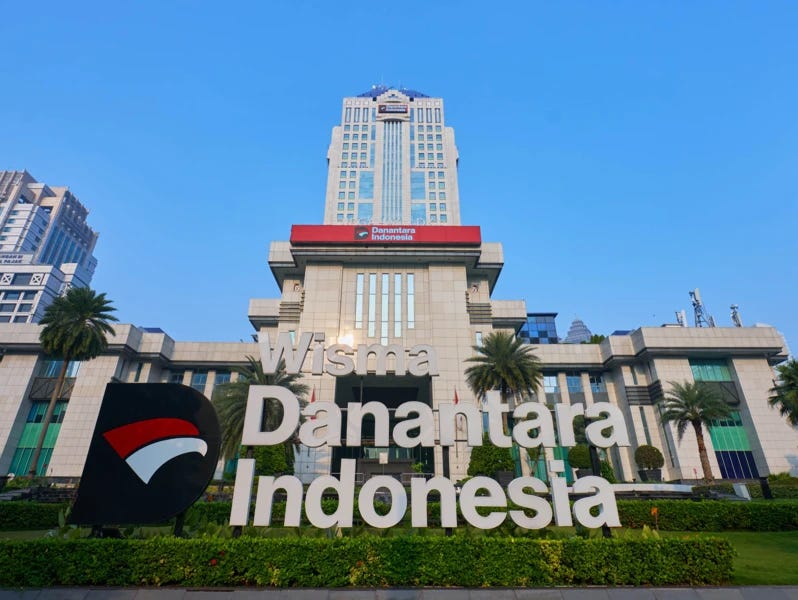
Indonesia Infrastructure Finance (IIF) has extended Rp601.4 billion (US$33.1 million) to two projects, including US$20 million for Digital Edge’s GAIA data centre campus in Bekasi, near Jakarta. The loan backs the campus’s first phase of 58.9 megawatts, while the rest funds a heart hospital in Medan. Tencent is also expanding overseas data centres after demand for its AI services abroad grew at a triple-digit pace, with Indonesia among its priority markets. It has already pledged US$500 million for a third data centre in the country. Local lenders and global tech giants are converging on the same bet: Indonesia’s AI and cloud demand needs far more capacity at home.
Roblox Puts a Regional Chief on the Ground
Roblox has named Malaysian founder Joel Neoh, who co-founded the deals app Fave, as managing director for Southeast Asia and Oceania. He joined in October and will lead regional strategy, brand partnerships and the platform’s creator economy. Indonesia is a key test, since Roblox is one of eight platforms classed as high risk under PP Tunas, the child online protection rule in force since March. The company committed in April to full compliance, including age verification and limits on accounts for users under 16. A senior leader in the region should help Roblox grow responsibly in a market of roughly 70 million children.
Indodax Reopens After a Cautious Pause
Indonesian crypto exchange Indodax began restoring services on October 31 after pausing deposits and withdrawals when it spotted unusual activity two days earlier. A review of its trading, wallet and account systems found no lost assets, no unauthorised transfers and no leaked user data, CEO William Sutanto said. The quick, conservative response is a contrast to 2024, when a hack cost the exchange about US$22 million. With regulator OJK counting 23.2 million crypto users in August, careful incident handling like this is what keeps a growing market’s trust.
What’s Next: AI Literacy Becomes Tech Hiring’s New Baseline
Hiring appetite is returning, and Asia is leading it. ManpowerGroup’s Q4 2026 survey puts the global Net Employment Outlook at 29%. Asia Pacific and the Middle East (APME) sits higher at 33%, and the Information sector, which includes tech, is the strongest at 42%. The shape of hiring is changing, though. SignalFire finds total hiring at big tech firms is still 25% below 2019 levels as companies run leaner teams with AI. Asia is bucking that junior squeeze: 45% of APME employers increased early-career hiring over the past year, against just 18% who cut back.
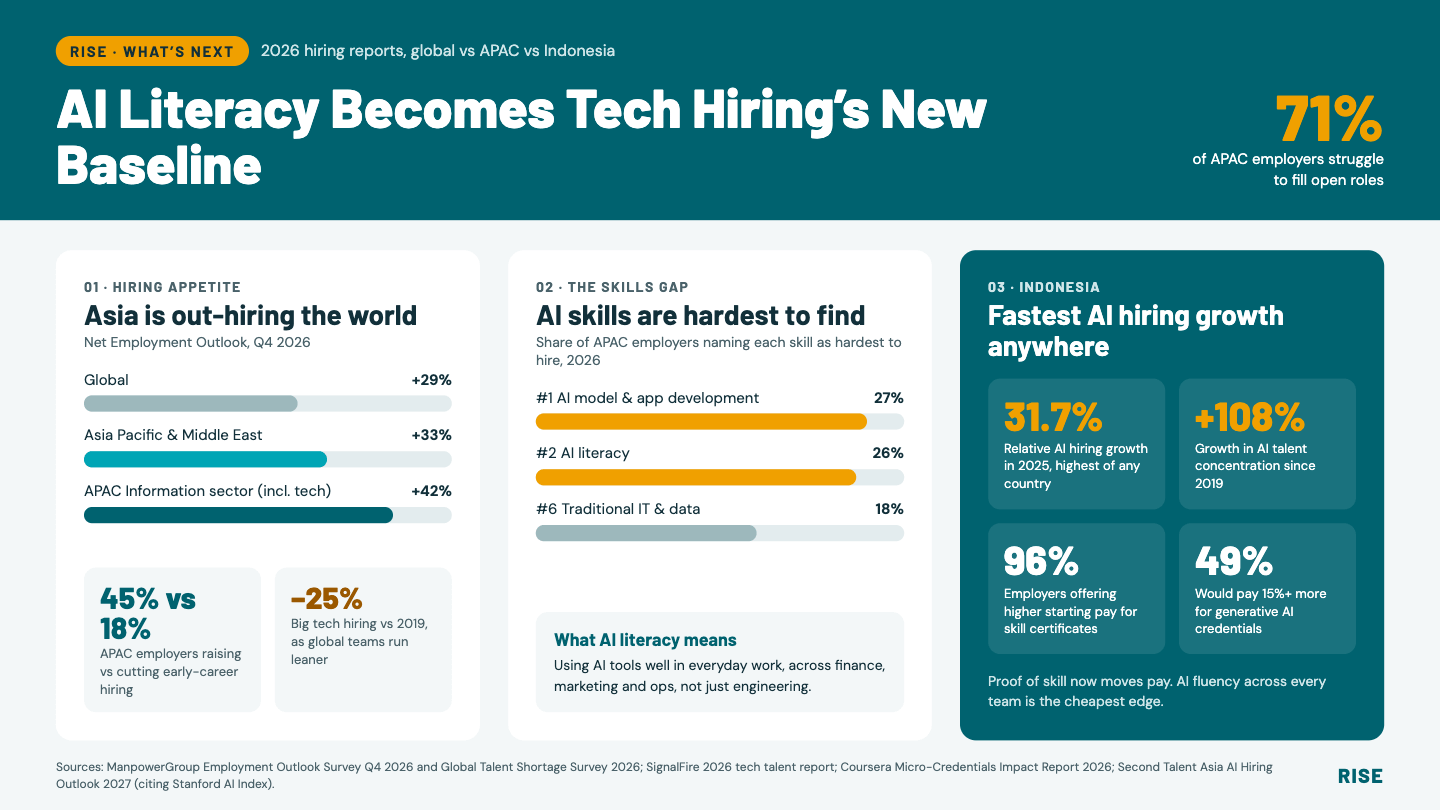
The bottleneck is skills, not demand. In ManpowerGroup’s 2026 Talent Shortage Survey, 71% of APME employers say they struggle to fill roles. The hardest skills to find are AI model and application development (27%) and AI literacy (26%), meaning the ability to use AI tools well in everyday work. Traditional IT and data skills rank only sixth, at 18%. Indonesia is moving fastest on this front. A regional outlook citing Stanford’s AI Index puts the country’s relative AI hiring growth at 31.7% in 2025, the highest of any country, with its AI talent concentration up 108% since 2019.
For Indonesian employers, proof of skill is starting to matter as much as a degree. Coursera’s Micro-Credentials Impact Report 2026 finds 96% of Indonesian employers would offer higher starting pay to graduates with short, industry-recognised certificates. Nearly half would pay more than 15% extra for generative AI credentials. Demand still centres on software engineers, data scientists, product managers, UI/UX designers and cybersecurity specialists, according to Michael Page’s salary guide. The opportunity for founders is clear. Hiring for AI fluency across every team, not just engineering, and building in-house upskilling could be the cheapest edge in a market where AI-ready talent is still scarce.
]]>






Komentar (0)